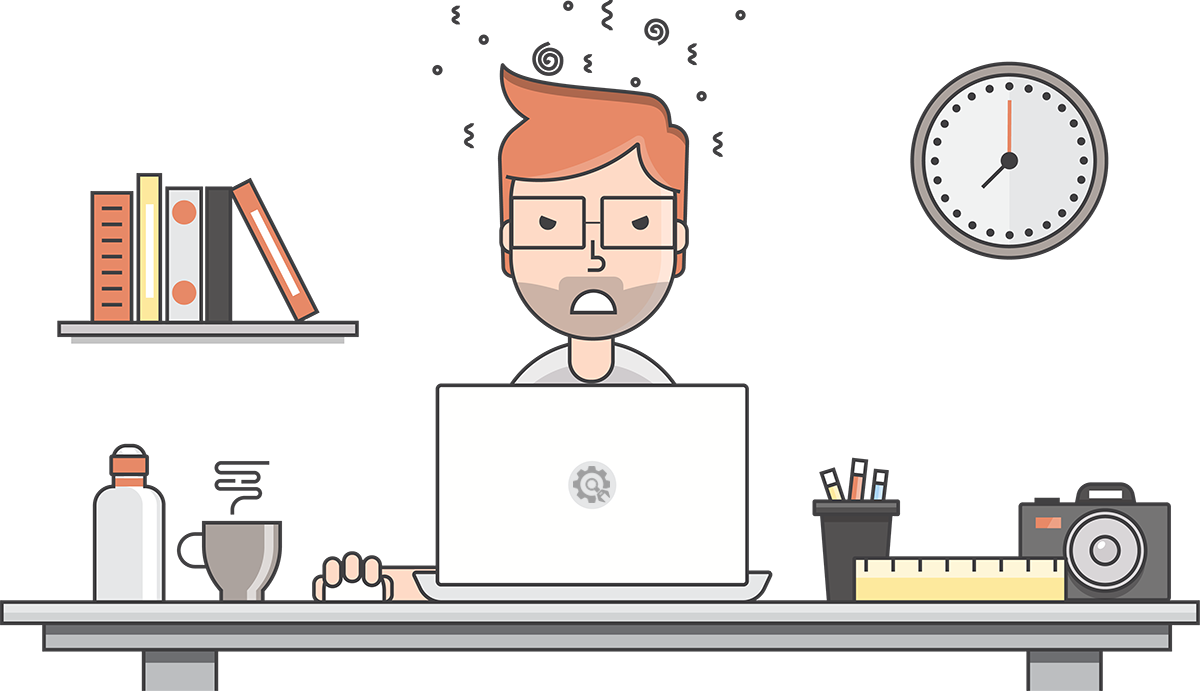
Why Distractions Grab Us

August 4, 2009

Our worlds are filled with distractions – emails, loud conversations, cell phones, radios and televisions–the list seems endless. But why do these grab and hold our attention when we have projects that are important or urgent?

In her book “Rapt” Winifred Gallagher takes a close look at the science of paying attention. Apparently our brains are hardwired to focus on the most “colorful” thing in our environment; read this as loud, interesting or literally colorful. Brain scans show our brains light differently up when these kinds of events invade our environment.

It is certainly difficult to fight this biologically based pull, and even more so if your brain is hyper-sensitive to distractions. But science shows that we can pull our attention away from a sight or sound that grabs our attention. We can use our pre-frontal cortex, the aware thinking part of the brain to override the intrusion. With practice and solid techniques we can improve our capacity to focus.

We can increase our abilities through biofeedback, regular meditation and cues that invoke our thinking. Ms. Gallagher is a fan of meditation to increase focus, but she admits to using an even simpler method when she’s trapped in a noisy environment – earplugs. She compares this to a personal stimulus control shelter. This is similar to my suggestion to my clients that they consider facing the wall rather than the crowd in a restaurant.

Ms. Gallagher says that after a period of concentration, our prefrontal cortex probably needs a break.  Simple tasks like answering e-mail or returning phone calls can help us rest and be ready to focus again. Beware of getting distracted though, because after an interruption the brain can take 20 minutes to do its equivalent of rebooting and refocusing.

Ms. Gallagher also feels that “Multitasking is a myth.” “You cannot do two things at once. The mechanism of attention is selection: it’s either this or it’s that. People don’t understand that attention is a finite resource, like money.”

To have fewer distractions and fewer 20 minute periods of rebooting, try turning down the frequency of email retrieval, work on difficult or important projects first while your brain is most able to manage distractions well, and arrange uninterrupted work time. For more ideas consider talking with an experienced ADD coach.

Jay Livingston can be contacted at Jay@Livingstonservices.com or 978-446-9600

Competing with a Computer Screen

June 16, 2009

Marty sat talking to me with his eyes on his computer screen and regularly input burst of typing. I tried sitting at the other end of his desk so he would be forced to look away from the screen, but he just pushed his chair back and swung his head from the screen to me until I lost out and he was back to starring at the screen.

More and more jobs seem to necessitate people keeping an eye out for incoming emails or require the completion of a computer form as part of the appointment process. I first encountered this at a specialist’s office where the physician did a remarkably thorough job, but rarely looked up from his screen. Now I see my ADD clients struggle with it.

Some people think I’m entertaining and my wife even thinks I’m funny, but I couldn’t get Marty to take his eyes off his screen. I reminded him that he was not paying attention and he apologized but quickly drifted back. I finally asked him to turn off the monitor while we talked about what to do. He was very willing, but the interesting thing was he kept checking the blank screen every 15 to 30 seconds. That was better though because he would check in with me more often and his conversation was more responsive.

The computer is a huge time safer and it is a huge interruption and distraction. Those with ADD have to be particularly vigilant about letting it dominate their day. A few suggestions:

·         Turn off the monitor when you’re having meetings or business conversations; it’s easy to fire it back up again.

·         Close the email program or set it to not go looking for email but once an hour – you can always manually click the send/receive button.

·         Turn off all signals that you have email and set a kitchen timer for one hour to remind you to check.

·         Move away from your desk when you’re having a business conversation so that you’re not distracted by other non-technological things on your desk.

·         Get a squeeze ball or some other fidget toy to play with while you talk.

Marty came up with an interesting solution on his own, he now takes notes with a pen while we talk; of course he spends a lot of time starring at his notebook. Funny but that doesn’t bother me nearly as much.

Jay Livingston can be contacted at Jay@LivingstonServices.com

Singing Our Own Songs

June 5, 2009

“The mass of men lead lives of quiet desperation.”

Henry David Thoreau


“Alas for those that never sing, but die with all their music in them.”

Oliver Wendell Holmes


Recently, a therapy client referenced Henry David Thoreau’s quote about men who live in “quiet isolation.” This individual felt a strong connection to the notion that most of us live within ourselves, hidden from those around us. When I went to research more about Thoreau’s work, I happened upon the famous Oliver Wendell Holmes line, “for those that never sing, but die with all their music in them.” The quotes from these two authors are often merged to read, “Most men lead lives of quiet desperation and go to the grave with the song still in them.”

The words of Thoreau and Holmes were penned in the mid-1800’s, but I suspect that they are more relevant today than ever before. What a sin it is to quietly despair, not sharing our thoughts, joys, worries and hopes with others. There are many reasons why so many of us live in hiding. One of the most obvious is the fact that, as a society, we have placed such an ever-increasing emphasis on independence that we have left little room for the importance of “community.” We communicate through text messages and emails with people across the globe while too often not even knowing our neighbors.

But there is an even more pervasive reason why we keep ourselves hidden from those around us. Too many of us are burdened by a sense of shame. As a therapist, I can attest to the power of shame, and there is no shortage for the causes of shame. We feel shame about our shape, size, professional status, athletic performance, and school achievement. Feelings are also a powerful source of shame. When we experience depression, self-doubt, anxiety and fear, we mistakenly believe that no one else would understand, and even worse, that we will be ridiculed after admitting to feeling frail. In short, we hide from others so they won’t see how “deformed” we feel we truly are.

Just this morning, a member of my men’s group summed it up like this: “I’ve been hiding out…being this way in life is not very fun.” Another group member, while sharing a recent breakthrough in communication with his wife, said, “telling others how you feel is the center of everything.” Having the freedom to share ourselves fully is, to paraphrase Oliver Wendell Holmes, the act of singing our own deeply personal songs.

And so I ask you, what songs have you sung lately? Who knows how you feel? Who have you cried to, laughed with or held? “Dan” was right, life without connection to others isn’t very much fun at all. And if you are reading this and saying it’s too late for me, IT’S NEVER TOO LATE to connect to others. There are probably those around you already who would sit and listen. And if you don’t think you have anyone there for you, it’s okay to ask for help from a family member, a friend, someone at your house of worship, and yes, even a therapist. Life is too short to postpone the joy of connection!

Walter Sherburne, LICSW

Make an Appointment with Your Anxiety

May 5, 2009

Keeping Anxiety in Its Place

I was recently invited to give a talk to a group of clients from a financial planning firm. These successful people had good jobs, adequate savings and potentially rich lives. They were in no danger of losing it all in the current market situation, but there was an awful lot of worry and anxiety in the room.

Worry and anxiety are fear of something that might happen in the future; fear of something that hasn’t happened, isn’t happening and may never happen. When we allow worry to become a major player in our life, we are letting our fear of the future hijack our enjoyment of the present.

I wanted to give my audience some simple, practical methods to reduce their worries so I shared a technique with them that I teach some of my therapy clients.

Corral your worries into a specific time and place. Since worry is focused on a vague and uncertain time and event in the future, it isn’t anchored to any particular time and place now and therefore it can easily begin to creep into all your activities and situations. It’s crucial that you find away to give yourself a break from it.

Trying to ignore a worry is often no more effective than trying to not think about white elephants.  Thinking about not thinking is thinking about it. You get the idea. So I suggest you try giving the worry a specific time and place all of its own. Make an appointment to worry.

Imagine looking at your calendar. Choose a time when you will bring your attention to worries. For example, you can decide that you will worry from 3 to 3:30 every other day. When you find yourself starting to worry at any other time, your job is to stop, notice what’s happening and promise to spend time worrying tomorrow between 3 and 3:30. Then you attempt to return to a productive or pleasurable activity. If the worry comes up again, you note it and promise to spend time at the next designated worry appointment . If you have multiple worries, keep a list of all the things you want to worry about during your scheduled time so you don’t forget any.

For this to work you have to fulfill your commitment to actually take the time to worry. You won’t put the worry aside if you know you might not take the time to focus on it later. Keep your appointment and worry. You may find that worry takes another form; it might end up being less like diffuse fretting and more like actual problems to be attended to. Build credibility with yourself and follow through by paying attention to whatever is on your mind that is concerning and preoccupying. Write, talk out loud—whatever is the best form of attending to your worries.

Each time you put aside the worry and make it wait for its time, you develop your ability to do that with less effort the next time. It’s like exercising in order to build a “wait for it” muscle. The new pattern begins to build new circuitry in your brain and it becomes easier and easier.

For more information about managing worry and anxiety you’re welcome to call for an appointment.  978-446-9600 or send me an email with your contact information.

 Szifra Birke 

(My name only looks impossible; it’s pronounced SHifra).


Honey is the Answer

April 24, 2009

Some sayings are familiar and end up being supported by research findings. “It’s easier to catch flies with honey than with vinegar,” is one example.

It would be surprising if you didn’t agree with the old saying, yet very few of us practice its advice in our daily lives. Well, researchers have proven once again that positive feedback is in fact more powerful than negative criticism at “catching” behavior change in a positive direction.

In one study, researchers videoed people bowling and then showed them the playback while pointing out either the mistakes they made or the things they did correctly; people improved much more with the positive feedback than with the negative.

Other studies have shown that parents of tough kids improve their parenting when their children’s positive actions are pointed out, and that people can be trained to change actions and behaviors with nothing but positive feedback.

There is a growing movement of consultants using “Appreciative Inquiry” to help businesses and organizations solve long-standing problems and develop new strategies. Those of us who have practiced these approaches with organizations and with individuals are struggling for a descriptive label to identify positive approaches. “Appreciative Coaching” is a possibility as is “Positive Coaching.”

There is another group of us who wants to be sure that “Strength Based Coaching” is properly placed with the other positive approaches. Recognizing and building on strengths is a pivotal aspect of many approaches.

The bottom line is to be selective, choose to work with someone who appreciates your strengths and will reflect the most positive aspects of you living your life well. Be certain your coach gives at least 3 to 1 positive to negative feedback and holds a vision of a brighter future that builds on your strengths.

Is this a Pollyanna approach? No, it just focuses on where you want to head, not where you tripped.

For more information call Jay Livingston at 978-446-9600, email me at Jay@LivingstonServices.com or visit my website at www.LivingstonServices.com

ADHD Parenting Tip: Do Something Entirely Unexpected With Your Child

February 18, 2009

Here in New England, for many students it is February break from school.  For me, I fully understand the emotional “letdown” of having some time off.  And by letdown, I mean the total relaxation that can happen.  My wife is a teacher here in the greater metro-Boston area, and I witness first-hand what happens during these brief breaks from school:

  • Schedules can be thrown out the window
  • Lots of things to be done (waiting to be done)
  • Competing attention for wants, needs, and desires
  • Lingering time
  • And so much more…

There is something to be said about sticking to a schedule.  After all, they provide a framework for getting things done, expecting what will happen, and being able to turn to some “known quantity” when things turn to a struggle.

Yet, at the same time I tell parents to stick to a schedule, there are also incredibly important reasons to throw that schedule out the window.

Breaks from school are in some ways meant to be a break from the same old routine that can make any child or family feel suffocated or mundane.

Now, I’ll apply the standard – individual clause – in this case.  And by that I mean, who sticks to a schedule, when they stick to it, and how closely they stick to it will differ from family to family and child to child.  There is no standard advice for what you should be doing.  Just know that children with ADHD benefit from structure and famililiarty.

So What?

I am sharing all of this because it is incredibly important to keep in mind that life should be fun, free, and spontaneous (at times).  Children want to do fun things, and believe it or not, they want to do fun things with their parents.

They might not always admit it, and they might even play hard to get…but deep down inside they’ll be happy to do something fun.  But here’s the catch… The fun has to be something they want to do.

So this week, if things get a little overwhelming or you are stuck on how to spend the time – do something unexpected with your child. Let them pick the activity, and then you should get involved in it.

Let go of exepctations and just have some fun.

The ADHD Dance

January 4, 2009


My dog knows I struggle with planning the steps needed to complete some tasks. Well, he probably isn’t actually aware that I struggle, and come to think of it I don’t so much struggle as sometimes simply skip some of the planning.


This all became clear to me as I got giggling at myself the other day. I was reading “Spark,” John Ratey’s new book. He describes what he calls the “pirouette” as his ADHD patients leave a session only to spin back to retrieve their keys or cell phone. I realized I was doing my version of the ADHD dance as I left my house on the way to the office, and my dog was watching the whole process.


I pick up my purse and tea mug, say goodbye to the dog and walk out the door. Sometimes I make it to the car before I hurry back in to retrieve a paper or book I want to share with a client and then I’m out again. Often I’m back in again to grab my gym bag or yoga mat. All the time my dog is quietly watching me come in and out organizing my leaving as a sort of “in action” style of planning.


ADHD is diagnosed through a series of recognizable attributes, but those same attributes are shared by many people who aren’t diagnosable with ADHD. I also like Ratey’s term to describe these people with ADHD style symptoms but not the full blown diagnosis; he calls this “shadow” ADHD.


Understanding this notion can be a real help to individuals who feel the diagnosis has essentially pushed them into an image of themselves that makes them uncomfortable. Having the diagnosis doesn’t make you completely different from others, just different in the specifics of your style of coping with life.


Those with ADHD are only distinct from many, many others in the severity or complexity of their issues. They are in step with the American dance, just doing their footwork to a slightly faster more complex beat and occasionally stepping on their own toe.


Living Successfully with ADHD is About Balance

December 29, 2008

As I get the opportunity to tackel another new year in my life I am convinced that healthy living, for those with and without ADHD, is about moderation and balance: eating, exercise, work and play all require an ability to moderate. But moderation doesn’t mean avoiding the peaks of exhilaration or ignoring our superior talents. At times, we simply need to strive to be the best we can be, and then we need to relax enjoy less than perfection.

There is a moderation or balance necessary as we choose whether to focus on using our strengths or developing our weaker attributes.

I once worked with a business owner who had developed a complex piece of medical equipment that was being used “experimentally” in dozens of hospitals. He hadn’t ever submitted the paperwork to the FDA for approval for its manufacture and use as an “approved” device. The owner was a brilliant technician who couldn’t manage his time, set priorities or direct his employees. When I came on board the FDA was on the verge of shutting the whole operation down for want of a detailed and ordered list of manufacturing steps. The owner just couldn’t produce the list; he didn’t think in that kind of sequential way.

Each of us has a constellation of personal attributes, on one end of the spectrum are strengths that lead to successful actions, and on the other end are weaknesses that restrain our success or cause us to regularly stumble. The common wisdom, and what many people challenged by ADHD have consistently heard, is that you need to develop the areas you’re weak in.

There’s truth in that encouragement (or reproach?), but there’s also a misunderstanding of how success seems to work. Getting to sustainable success takes a balanced approach; we need to focus on our strengths and find ways to work around certain core social/professional attributes that we are weak in, like my business owner not being able to set priorities.

We wouldn’t expect a football player to necessarily be a top level engineer or a commercial pilot to also be an exceptional lawyer. Professionals who excel focus on playing to their strengths. There are some skills, however, that are called upon day in and day out and even if we aren’t exceptional in those areas we need to be able to get by. The trick is to develop enough skill to predictably meet your obligations, but to keep a major focus on using your areas of strength to drive you toward success.

A position that requires you to make excellent estimates of time or to work in an unstructured environment, but meet precise goals, may well put unreasonable demands on your weaknesses, whereas a partner who loves keeping an eye on the details may allow you to shift focus to using your strengths.

We can’t always choose which attributes we will need, but we can try to be sure that the majority of demands on us play to our strengths and try to minimize the need for us to struggle with our weaknesses. To not keep that balance may well derail the possibility of success.

I hope your new year brings satisfying successes, insight and growth.


Committing to Change an Old Habit

November 24, 2008

A coaching client I was working with this week, who has an ADHD diagnosis, wanted to make a commitment to himself to increase his phone calls to prospective clients; sounds good, except he has tried this more than half a dozen times without successfully following up.

This time I encouraged him to not make the commitment. I felt he still didn’t have a realistic chance of fulfilling it, and if he had made the commitment and not followed through on it again, the value of all his commitments would just continue to erode.

In my coaching, I’m always looking for ways to help my clients bring a higher level of awareness and motivation to the task of changing their habits. A commitment is a classic and sometimes powerful method, but part of its potential power is in its ability to draw attention to a situation – to create a “different than life as usual” moment.

Making a commitment stand out – catch your attention – means it needs to be thought through carefully and it has to marshal your best efforts. Taking the time to make a deliberate decision before making a very specific commitment, even to yourself, raises the value of your commitments and the chances they will be effective.

My client and I spent the last half of our session identifying what strategies he could use to increase the odds that he would successfully follow through this time. He ended up making a commitment to do something he was sure he could accomplish, create the tracking sheet he would use when he was ready to move forward on the phone calls. If he is successful at completing the new form, his subsequent commitments may be even more powerful motivators.

Don’t over commit!

ADHD and Your Self Esteem

October 27, 2008

Many of my clients are successful public speakers, entrepreneurs, and CEO’s, and yet many have the feeling that at any moment they will be “found out”.

My work with adults with ADD and ADHD includes looking at and trying to correct old messages implanted by unaware parents and teachers – you know, the “You’re lazy”, “You’re unmotivated and will never amount to anything”, “How stupid can one person be?” messages.

Sam, a very active, extremely bright and super busy CEO I work with, owns his own company, and even with the current economic mess, has a net worth in the double digit millions—all self-made.  He also owns a self-concept badly in need of repair.  As a boy and adolescent he was told he would never succeed, that he was stupid, couldn’t learn, was undisciplined and wouldn’t even make it to his own funeral. On some bad days, he feels just like that boy/adolescent again as those old messages come swimming back into his head.

Sam got sick of beating himself up based on other peoples’ messages and finally made time to slow down and try to understand himself better. (I know, slow down sounds dreadful, but don’t worry, I have plenty of things to fiddle with in my office and I’m not opposed to taking a walk if needed). Sam and I are working to update his self-esteem file to have a more realistic picture of himself. In just three meetings, Sam has begun to recognize times he’s putting himself down and can sometimes stop, get current and remind himself of the countless strengths and talents he has.

Don’t hesitate to contact a therapist or coach if you are an adult who suspects you have attention deficit disorder, with or without hyperactivity. Your peace of mind is worth it.


« Previous PageNext Page »

Services

Cerulli & Associates is an integrative, holistic treatment center with a focus on health and wellness. Our unique style and approach takes into consideration the entire person, and NOT just the problems they are struggling to manage.

Continue reading...

Programs

We offer a variety of coaching programs, training, and support groups both on-site and online. Our goal is to make sure you have access to the information you need, when you need it.

Continue reading...